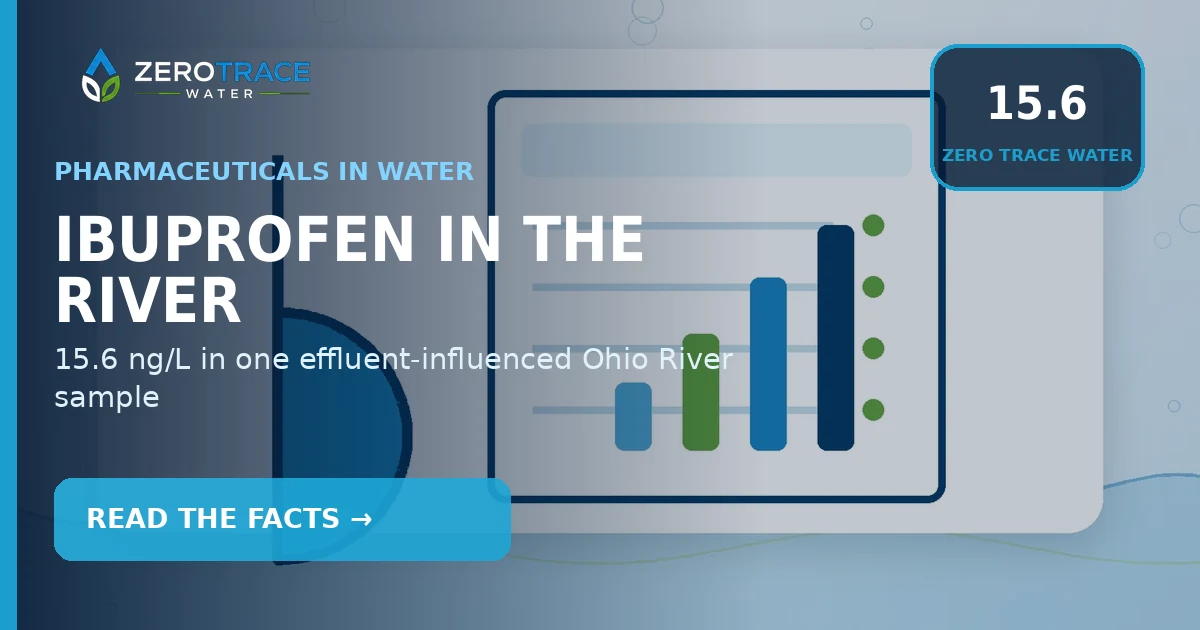
In ORSANCO’s Louisville-area screening, ibuprofen was below the reporting limit at the mainstem sample and measured at 15.6 ng/L at the effluent-influenced sample. That is a river-screening result, not proof of that level in treated household water or proof of a health effect.
- Sample 17 at river mile 600.5: ibuprofen below the reporting limit
- Sample 18 at river mile 612.2: 15.6 ng/L
- Sample 18 was deliberately labeled effluent influenced
- The study was designed to map occurrence and guide future research
Ibuprofen is so common that it can feel almost harmless: a bottle in the medicine cabinet, a tablet after a headache, a routine part of daily life. That familiarity is exactly why the environmental pathway matters. A medication used by millions does not disappear when the pain does. After normal use, some of the active compound and its metabolites leave the body, enter wastewater, and can reach rivers at trace concentrations.
In ORSANCO’s 2009 Ohio River screening near Louisville, ibuprofen was below the method reporting limit in a mainstem sample at river mile 600.5. At a second location, river mile 612.2, deliberately labeled effluent influenced, the laboratory reported 15.6 nanograms per liter. That is a real detection. It was not a test of finished Louisville drinking water, and it did not prove that the measured concentration created a human-health effect.
What the two nearby samples tell us
The contrast between samples 17 and 18 is more informative than the number by itself. Sample 17 represented the Ohio River mainstem. Sample 18 was selected because it was influenced by an effluent discharge. The mainstem result was below the reporting threshold, while the effluent-influenced result was 15.6 ng/L. Naproxen, another pain reliever, showed a similar pattern: below the reporting limit in sample 17 and 13.3 ng/L in sample 18.
That pattern supports the study’s purpose—identifying where contaminants of emerging concern occur and how wastewater discharges may affect river concentrations. It does not establish that every downstream point had the same level. Grab samples are snapshots. Concentrations can change with river flow, rainfall, season, wastewater operations, medication use, and the time of day.
Nanograms per liter are parts per trillion. A therapeutic ibuprofen tablet contains hundreds of milligrams, many orders of magnitude more than 15.6 ng in a liter. Comparing the numbers does not complete a risk assessment, but it helps prevent a trace detection from being mistaken for a medicinal dose.
How ibuprofen enters the water cycle
People excrete a portion of medications after use, sometimes as the original compound and sometimes as metabolites. Those residues enter municipal sewers or septic systems. Hospitals, care facilities, pharmaceutical manufacturing, and improper disposal can add other inputs. When unused pills are flushed, the medication is sent directly into a treatment pathway that was not designed around every pharmaceutical molecule.
Wastewater plants are highly effective at their core jobs, including removing solids and reducing pathogens and conventional pollutants. Their performance on pharmaceuticals varies by compound and process. Some chemicals biodegrade. Some attach to solids. Some are transformed into other compounds. Others pass through at low concentrations. Advanced oxidation, activated carbon, ozonation, and membrane processes can improve removal in some applications, but they are not universally installed or equally effective for every compound.
The river then becomes source water for downstream communities. Drinking-water plants apply additional barriers before water enters distribution. That is why a wastewater-effluent result, an Ohio River result, a finished-plant result, and a household tap result must never be treated as interchangeable.
What ORSANCO concluded—and did not conclude
ORSANCO described the project as a preliminary screening study intended to document occurrence and shape future research. The report noted that analytical improvements made it possible to detect compounds at extremely low levels. It also said limited evidence was available at the time to conclude that environmental occurrences of the targeted compounds caused a human-health risk.
That statement should not be rewritten as “pharmaceuticals in water are harmless.” It means the screening detections alone were insufficient to prove causation. Risk assessment requires toxicity data, a realistic exposure estimate, duration, sensitive populations, mixture effects, and the treatment steps between source water and consumption.
The reverse is also true: a result below the method reporting limit should not be marketed as proof of absolute absence. It tells us the laboratory did not report a reliable numerical concentration above that method’s threshold in that sample.
Why the 2026 EPA pharmaceutical benchmarks matter
In April 2026, EPA released human-health benchmarks for 374 pharmaceuticals that may occur in source water or treated drinking water. The agency provides separate values for the general population and infants. These benchmarks are nonregulatory. They are screening values that can help states, Tribes, utilities, and researchers decide whether a detected concentration warrants more investigation.
The benchmark program shows how the science is maturing. A decade-old river survey documented occurrence. Newer federal tools help place some detections into a health-screening context. Neither replaces a site-specific water sample, and neither means every pharmaceutical now has an enforceable drinking-water limit.
Homeowners should be skeptical when a product seller cites a detection but omits the benchmark, sample type, or treatment stage. Fear without scale is not education.
Responsible medication disposal is source control
The simplest household action is not a filter. It is preventing unnecessary pharmaceutical waste from entering plumbing. Use authorized medication take-back programs whenever possible. Follow FDA or local instructions when take-back is unavailable, and do not flush medication unless the label or official guidance specifically directs it.
Source control will not eliminate residues created by normal use, but it prevents avoidable disposal. It also reduces the risk of accidental poisoning, diversion, and misuse. The gain is broader than water quality.
Can a home treatment system reduce ibuprofen?
Some activated-carbon and reverse-osmosis systems can reduce selected pharmaceutical compounds. NSF/ANSI 401 addresses selected emerging-contaminant claims for specific products. A product may be certified for one compound and not another. An NSF mark on a housing or component does not prove the complete installed system has an ibuprofen claim.
Carbon performance depends on pore structure, contact time, flow, water chemistry, and remaining capacity. Reverse-osmosis performance depends on the membrane, pressure, prefiltration, storage, sanitation, and maintenance. A neglected system cannot be assumed to perform like the product in a certification test.
Before buying, ask for the exact manufacturer and model, the official certification listing, the named compound, tested capacity, rated flow, and replacement schedule. Then decide whether treatment is needed at the kitchen sink or throughout the home. For a concern tied primarily to ingestion, a point-of-use system can often focus treatment and maintenance where it matters most.
Read the ZeroTrace Water filter-claim guide and the reverse-osmosis service overview for a practical comparison.
The gain: act on the pathway, not the shock value
The hard truth is that a familiar pain reliever can become an environmental contaminant after use. The local data also show why context protects people from bad conclusions: ibuprofen was below the reporting limit in one mainstem sample and measured at 15.6 ng/L in one effluent-influenced river sample. Neither result was a kitchen-tap test.
A useful response combines source control, current monitoring, targeted testing when justified, verified treatment claims, and disciplined maintenance. That approach may not create the loudest headline, but it produces the strongest household decision.
This article uses source-specific language. River, wastewater, raw-water, finished-water, and tap-water results are not treated as interchangeable. Detection does not automatically establish a health effect, and a regulatory change does not erase toxicology. Information is educational and not medical advice.
Primary sources and further reading
- ORSANCO: Screening Study of Emerging Contaminants in the Ohio River Basin
- ORSANCO study PDF
- U.S. EPA: Impact of Pharmaceuticals Released to the Environment
- U.S. EPA: 2026 Human Health Benchmarks for Pharmaceuticals
Frequently asked questions
How does ibuprofen get into a river?
A major pathway is normal human use followed by excretion into wastewater. Improper disposal can add to the load. Wastewater treatment reduces many contaminants but is not designed to eliminate every trace compound.
Was 15.6 ng/L found in tap water?
No. It was reported in an effluent-influenced Ohio River surface-water sample. Finished drinking water was not what that sample represented.
What is the most useful household action?
Use medication take-back options instead of flushing unused drugs, read utility reports, and verify the exact reduction claim of any treatment device rather than buying from a broad ‘removes pharmaceuticals’ promise.