
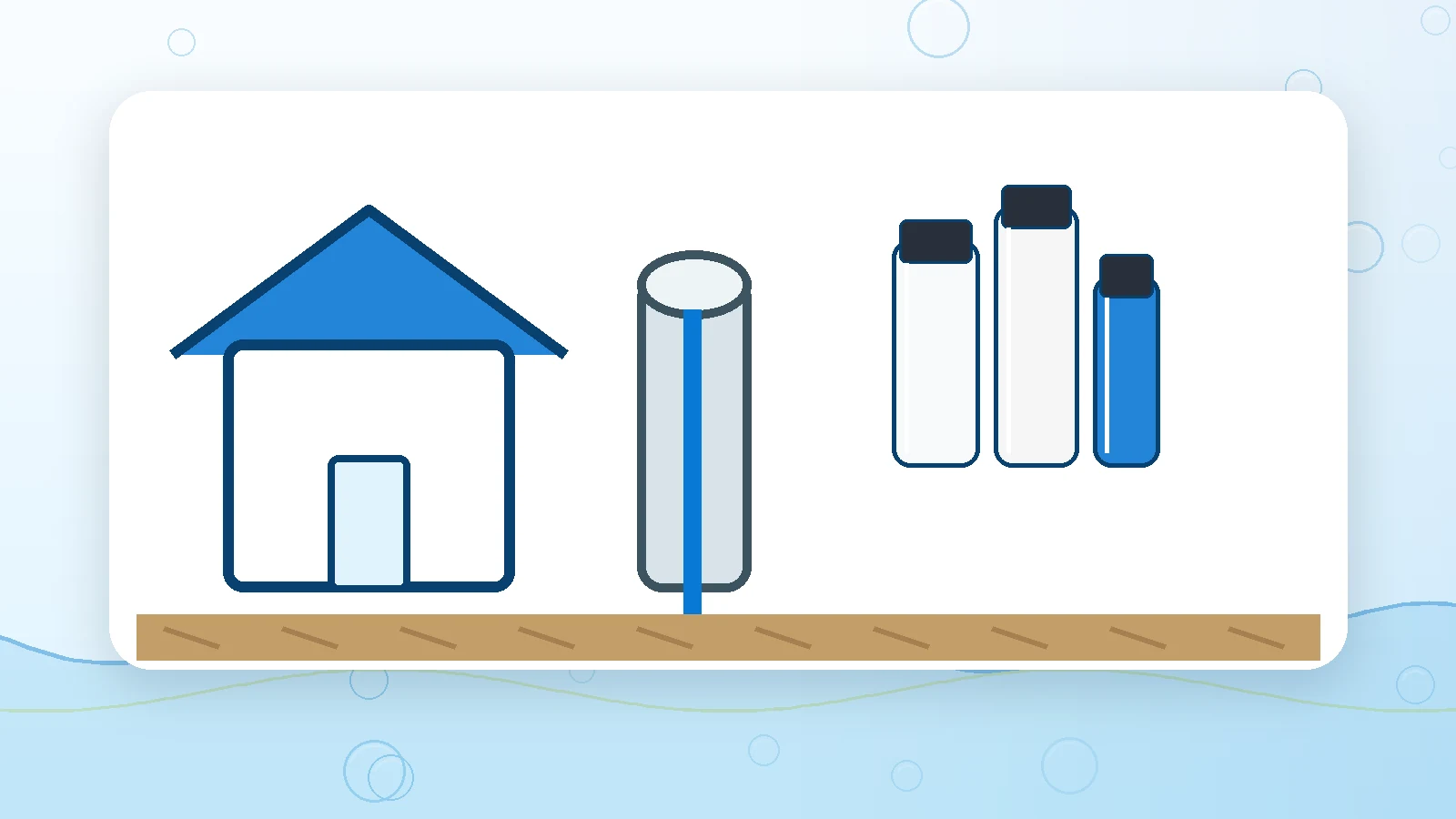
ZeroTrace Water helps homeowners move from water testing to a complete installed solution. Recommendations are matched to the water source, measured concerns, household demand, plumbing conditions, and the exact performance claims of the proposed equipment. Ask for a written proposal covering equipment, installation, startup, maintenance, warranty terms, cash price, and available third-party financing.
Last reviewed: July 26, 2026
Quick answer
There is no universal well-water treatment system for properties in the Louisville area. Private wells are not monitored like public water systems, and the owner is responsible for testing, well condition, treatment, and maintenance. Kentucky advises annual testing through a certified laboratory and requires certified well drillers for construction, alteration, or repair work. A treatment plan should begin with the well record, inspection, sample design, laboratory results, household flow, and the exact target - such as bacteria, nitrate, hardness, iron, manganese, sediment, sulfur odor, pH, or another measured condition.
Why is private-well treatment different from public-water filtration?
A public water customer receives water from a regulated utility that treats and monitors the system. A private-well owner is responsible for the source, construction, protection, testing, treatment, and response. EPA and CDC both emphasize that federal public-water rules do not apply to privately owned wells. Kentucky's Division of Water provides well-owner resources and states that private-well or cistern users should test annually using a certified laboratory.
That difference changes the sales conversation. A whole-house filter selected from a symptom alone can miss a health-related contaminant, overload the equipment, or treat the wrong source. The well itself may need repair, sealing, disinfection, drainage correction, or protection before a treatment device is appropriate. Construction, alteration, and repair of a Kentucky well must be performed by a certified water-well driller.
What should be collected before treatment is designed?
- Well type, depth, age, construction record, casing, cap, location, yield, pump, pressure tank, and recent repairs.
- Nearby risks such as septic systems, agriculture, flooding, fuel or chemical storage, mining, landfills, and construction.
- Annual certified laboratory results and any event-driven testing after flooding, repairs, a change in taste or odor, or illness concerns.
- Household occupancy, peak flow, plumbing size, bathrooms, appliances, outdoor use, and low-yield or storage limitations.
- Raw-water sample points before treatment and treated sample points after the relevant stage.
- Existing equipment, bypasses, drains, electrical supply, media, salt or chemical use, service history, and failure symptoms.
Which tests are usually part of a well-water plan?
CDC recommends testing private wells at least annually for total coliform bacteria, nitrates, total dissolved solids, and pH, with additional tests selected from local conditions. Kentucky advises certified-laboratory testing for bacteria and other contaminants such as nitrate. EPA's well guidance connects symptoms and nearby activities to additional analytes, including lead, copper, volatile organic compounds, pesticides, chloride, sulfate, metals, hardness, iron, manganese, and hydrogen sulfide.
The laboratory should supply the correct containers, preservatives, holding times, cooling instructions, and chain-of-custody procedure. A generic bottle and one collection method are not valid for every analyte. Microbiology, metals, volatile compounds, and PFAS each require different controls. The plan should be set before the sample is collected.
| Measured condition | Treatment path to investigate | Important limitation |
|---|---|---|
| Bacteria or microbial contamination | Well inspection and correction, disinfection, and possibly UV with proper pretreatment. | Do not rely on a sediment or carbon filter as disinfection. Retest after corrective work. |
| Nitrate | Certified point-of-use reverse osmosis, ion exchange, distillation, or another verified technology. | Boiling does not remove nitrate and may concentrate it. Use urgent official guidance when infants are involved. |
| Hardness | Ion-exchange softener or scale-control approach selected from hardness, flow, and household goals. | Softening does not disinfect water or prove removal of unrelated contaminants. |
| Iron, manganese, or sulfur odor | Source diagnosis, oxidation, filtration, aeration, catalytic media, or a model-specific combined system. | The form and concentration control the treatment. A water-heater odor may not originate in the well. |
| Sediment or turbidity | Well assessment, settling or spin-down stage, cartridge or backwashing filtration. | Sediment can be a symptom of well or pump problems that should be corrected at the source. |
| Low or high pH and corrosion | Neutralization or other chemistry-specific treatment plus plumbing evaluation. | Changing pH affects metals, scaling, disinfection, and downstream media. |
How is a treatment train assembled?
A treatment train is the ordered sequence of stages, and order matters. Sediment or turbidity may need to be controlled before UV. Oxidation may be required before iron or manganese filtration. A softener may be placed before or after other stages depending on the chemistry, media, and manufacturer requirements. Reverse osmosis is usually a point-of-use polishing stage rather than a substitute for whole-house source correction.
Every stage should have one defined job, a measurable input, a rated flow, a pressure budget, a service trigger, and a verification step. Adding more tanks does not automatically create better treatment. Unnecessary stages increase pressure loss, maintenance, cost, and the number of ways the system can fail.
Sizing well-water equipment for the property
The design must match both water chemistry and hydraulic conditions. Record the well yield, pump capacity, pressure-switch range, pressure-tank drawdown, plumbing size, peak household demand, and backwash or drain requirements. A backwashing filter may need a higher short-duration flow than the well or pump can supply. A system that works in a laboratory column can fail in a home if the service flow or backwash rate is wrong.
Low-yield wells may require storage and controlled pumping rather than simply larger treatment tanks. High sediment loading may require source correction or staged separation. The proposal should show the assumptions and identify who is responsible for well work, plumbing, electrical work, drainage, startup, and follow-up testing.
Commissioning and maintenance
Commissioning should document the installed sequence, valve positions, bypasses, pressure and flow before and after treatment, settings, media, salt or chemical dose, backwash and drain performance, UV intensity or alarm status when applicable, startup flush, leak check, and raw-versus-treated sample locations. The homeowner should receive model numbers, manuals, replacement parts, service intervals, warranty terms, and emergency bypass instructions.
Annual well testing continues after treatment is installed. A treatment device does not eliminate the need to monitor the source. Retest after flooding, repairs, changes in taste or odor, breakthrough, extended shutdown, or a health-related concern. Keep the well record, laboratory reports, equipment log, and service history together.
Frequently asked questions
How often should a private well be tested in Kentucky?
Kentucky and CDC guidance support annual testing, with additional testing after events or changes. The exact panel should reflect the well, property risks, geology, and prior results.
Can one whole-house filter treat every well-water problem?
No. Bacteria, nitrate, hardness, iron, sulfur odor, sediment, pH, and organic chemicals require different evidence and treatment mechanisms.
Should I disinfect the well or install a UV system?
That decision depends on the source of microbial contamination, well condition, laboratory results, and professional guidance. UV can be a treatment stage, but it does not repair a defective well and works best with appropriate pretreatment.
Can a water softener treat iron?
Some softeners can handle limited forms and concentrations of iron under specified conditions. Iron form, manganese, sulfur, pH, and fouling risk must be measured before relying on a softener.
Who can repair a water well in Kentucky?
Kentucky requires a certified water-well driller for well construction, alteration, or repair. Treatment-system plumbing and electrical work should also be assigned to properly qualified parties.
Should treated well water be retested?
Yes when the system is intended to address a health-related contaminant, after major service, and when performance changes. Compare raw and treated samples under a plan suited to the target.
A clearer next step
Assemble the well record, current certified laboratory results, household demand, and existing equipment before comparing systems. ZeroTrace Water's Louisville-area content should serve only verified coverage areas and should not imply that ZeroTrace performs well drilling, regulated laboratory analysis, or licensed work unless those relationships and responsibilities are confirmed.
Related resources
- Private well water testing
- Public water vs. private well treatment
- Home water testing in Louisville
- Iron and manganese in well water
- Rotten egg smell in well water
- Well water maintenance schedule
Questions homeowners often ask
How often should a private well be tested in Kentucky?
Kentucky and CDC guidance support annual testing, with additional testing after events or changes. The exact panel should reflect the well, property risks, geology, and prior results.
Can one whole-house filter treat every well-water problem?
No. Bacteria, nitrate, hardness, iron, sulfur odor, sediment, pH, and organic chemicals require different evidence and treatment mechanisms.
Should I disinfect the well or install a UV system?
That decision depends on the source of microbial contamination, well condition, laboratory results, and professional guidance. UV can be a treatment stage, but it does not repair a defective well and works best with appropriate pretreatment.
Can a water softener treat iron?
Some softeners can handle limited forms and concentrations of iron under specified conditions. Iron form, manganese, sulfur, pH, and fouling risk must be measured before relying on a softener.
Who can repair a water well in Kentucky?
Kentucky requires a certified water-well driller for well construction, alteration, or repair. Treatment-system plumbing and electrical work should also be assigned to properly qualified parties.
Should treated well water be retested?
Yes when the system is intended to address a health-related contaminant, after major service, and when performance changes. Compare raw and treated samples under a plan suited to the target.