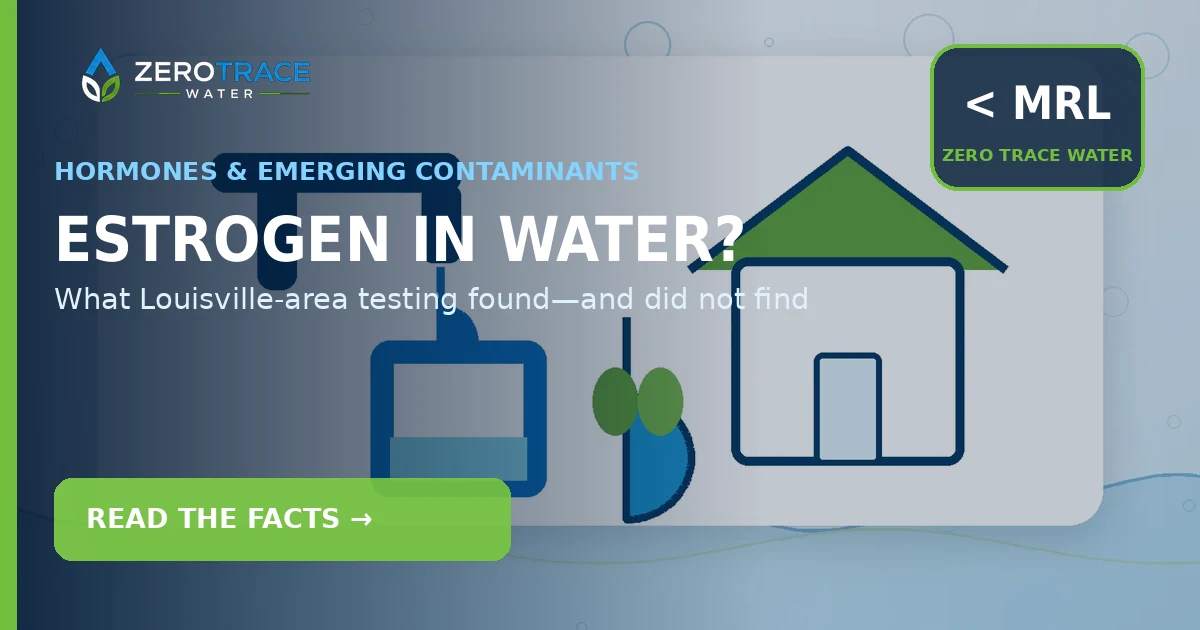
Hormones can enter waterways through human and animal waste, wastewater effluent, and runoff. In ORSANCO’s 2009 Ohio River samples near Louisville, the listed estrogenic hormones were below the method reporting limit, but that result applies only to the compounds, samples, methods, and date tested.
- ORSANCO screened 27 hormones and sterols basin-wide
- Local samples 17 and 18 were collected near river miles 600.5 and 612.2
- Estrone, 17-alpha estradiol, and other listed hormones were below reporting limits in those samples
- Below a reporting limit does not mean mathematically zero
Estrogen in drinking water is a frightening idea because hormones are biologically active at very low levels. The pathway is real: natural and synthetic hormones can enter wastewater through human and animal excretion, pharmaceutical use, agricultural runoff, and some industrial sources. The Louisville-area evidence, however, is more nuanced than the headline. In a large ORSANCO screening study, the targeted estrogenic hormones in two Ohio River samples near Louisville were reported below the laboratory’s method reporting limit or with quality-control qualifiers—not as clear, reportable concentrations.
That does not prove the river contained “zero hormones.” It means the laboratory did not quantify those compounds above the validated reporting threshold in those particular samples, using those methods, on that date. The correct message is both reassuring and useful: the local samples did not show the dramatic hormone detections people may imagine, but the broader pathway is scientifically credible and worth monitoring.
Why hormones can reach rivers
Hormones are produced naturally by people and animals. Synthetic versions are used in medications, including some contraceptives and hormone therapies. After use, compounds and their metabolites can leave the body and enter sewer or septic systems. Animal operations and manure application can create additional runoff pathways. Wastewater treatment removes or transforms many contaminants, but conventional plants were not designed to guarantee complete removal of every endocrine-active compound.
Environmental scientists care because fish and other aquatic organisms live continuously in receiving waters. Endocrine-active compounds can interfere with hormone signaling, reproduction, development, and behavior in wildlife at concentrations that may be far below a therapeutic human dose. Evidence of ecological effects does not automatically establish a drinking-water health effect, but it explains why source control and wastewater research matter.
What ORSANCO tested near Louisville
ORSANCO’s 2009 basin-wide screening included 27 hormones and sterols. Near Louisville, sample 17 was collected from the Ohio River mainstem at river mile 600.5. Sample 18 was collected at river mile 612.2 and labeled effluent influenced. The target list included estrone, 17-alpha estradiol, 17-beta estradiol, estriol, mestranol, norethindrone, 17-alpha ethinyl estradiol, progesterone, norgestrel, testosterone, and related compounds.
For samples 17 and 18, the table lists estrone, 17-alpha estradiol, progesterone, estriol, and several others as below the method reporting limit. Some entries, including 17-beta estradiol and 17-alpha ethinyl estradiol, carry a “K” qualifier rather than a reported concentration. Quality-control qualifiers matter because they signal that a result did not meet all criteria needed for normal quantitative reporting.
The study was a screening project, not a declaration about every gallon of water. It used grab samples collected on a specific date. River flow, wastewater discharge, season, rainfall, upstream activity, laboratory method, and reporting limits can change the result. A 2009 sample cannot tell a homeowner the precise condition at a 2026 faucet.
Below the reporting limit is not the same as zero
Laboratories establish method reporting limits based on the validated performance of the analytical method. A result shown as “< MRL” means the laboratory did not report a reliable numerical concentration above that threshold. A tiny amount could be present below the limit, or the compound could be absent. The data alone cannot distinguish those possibilities.
This is one reason social-media claims such as “no estrogen found” or “estrogen is definitely in your tap” can both be misleading. The first overstates a non-detection. The second often jumps from a general pathway or a wastewater study to a specific household conclusion without a matching tap-water sample.
A well-designed test report should identify the sample matrix, collection location, date, method, reporting limit, units, qualifiers, and chain of custody. Without those details, a number has little decision value.
Does Louisville’s water-quality report cover every hormone?
Consumer Confidence Reports focus on regulated contaminants and other required monitoring. They provide important evidence about compliance, treatment, and system performance, but they are not an inventory of every natural or synthetic hormone. Emerging-contaminant research programs, special studies, and unregulated contaminant monitoring answer additional questions.
Louisville Water’s 2025 annual report says the system met state and federal guidelines with no violations for the 19th consecutive year. That is meaningful. It does not mean every compound in modern commerce was tested, nor does it mean each detected substance was literally zero. A utility report and a targeted hormone study serve different purposes.
Home plumbing also matters. A utility report describes the public system; it cannot fully characterize every building’s service line, stagnation pattern, fixture, filter, or water heater. Hormone concerns are less likely to originate from household plumbing than lead or copper concerns, but the general principle remains: sample location defines what the result can support.
Can a home filter reduce hormone-active compounds?
Some activated-carbon and reverse-osmosis systems can reduce selected organic micropollutants. NSF/ANSI 401 covers reduction claims for selected emerging compounds on specific products. It is not a universal “hormone filter” standard, and it does not cover every endocrine-active chemical. The product listing must be checked for the exact claim.
Carbon performance depends on compound properties, media type, contact time, flow, water chemistry, and remaining capacity. Reverse osmosis can reject many dissolved contaminants, but performance varies and the system requires prefilters, membrane replacement, sanitation, and proper installation. A treatment company should never promise removal of “all estrogen” or “all pharmaceuticals” without specific evidence.
For drinking and cooking water, a point-of-use system may provide a focused, maintainable barrier. Whole-house treatment serves a different goal and requires far more capacity. The best design begins with the target compound and the household’s actual exposure objective.
Practical steps that reduce uncertainty
First, avoid flushing unused medication. Use authorized take-back locations when available. Second, read the current Louisville Water report and emerging-contaminant information instead of relying on a decade-old study alone. Third, identify whether the concern is ecological, source-water occurrence, or a specific tap-water exposure question.
Fourth, only order laboratory testing when the result will guide a decision. Ask the laboratory which hormone compounds are included, the method reporting limits, sample handling requirements, and whether the method is appropriate for finished drinking water. Fifth, verify any treatment claim in an official certification listing and record replacement dates.
ZeroTrace Water’s emerging-contaminant filter guide explains how to read NSF/ANSI 401 and compare it with standards 53 and 58. The home water testing service page explains how to start with the question rather than an oversized test panel.
The gain: truth is more useful than panic
The unsettling truth is that biologically active compounds can enter waterways and affect aquatic life. The equally important truth is that the Louisville-area ORSANCO samples did not report the targeted estrogenic hormones at quantifiable levels. Those facts can coexist.
A homeowner gains control by refusing both extremes. Do not dismiss emerging contaminants simply because they are measured in tiny units. Do not assume a river or wastewater finding equals the same concentration at the tap. Use current data, precise sample language, verified treatment claims, and a maintenance plan. That is how concern becomes an informed decision rather than a sales tactic.
This article uses source-specific language. River, wastewater, raw-water, finished-water, and tap-water results are not treated as interchangeable. Detection does not automatically establish a health effect, and a regulatory change does not erase toxicology. Information is educational and not medical advice.
Primary sources and further reading
- ORSANCO: Screening Study of Emerging Contaminants in the Ohio River Basin
- ORSANCO study PDF
- U.S. EPA: 2026 Human Health Benchmarks for Pharmaceuticals
- NSF: NSF/ANSI 42, 53 and 401 Filtration Standards
Frequently asked questions
Was estrogen detected in the Louisville-area ORSANCO samples?
The report lists the targeted estrogenic hormones in samples 17 and 18 as below the method reporting limit or qualified, rather than as reportable concentrations.
Does below the reporting limit prove none was present?
No. It means the laboratory did not report a concentration above the method’s validated reporting threshold for that sample. It is not the same as absolute zero.
Can any filter remove every hormone-active compound?
No blanket claim should be assumed. Some products have certified reduction claims for selected emerging contaminants under NSF/ANSI 401, but the exact model, compound, capacity, and replacement schedule must be verified.