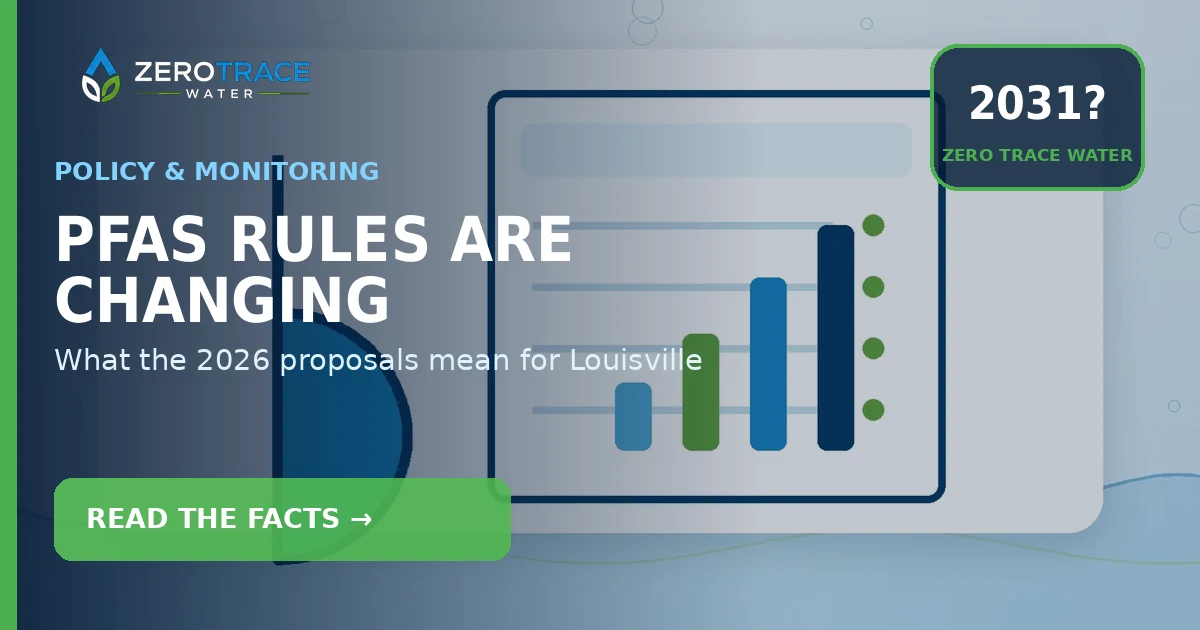
As of August 2026, EPA has proposed—not finalized—rescinding federal drinking-water requirements for GenX, PFNA, PFHxS, and the PFAS hazard-index mixture, while keeping the PFOA and PFOS limits and offering some systems a path to a 2031 compliance deadline.
- The 2024 rule established federal limits for six PFAS through individual limits and a hazard index
- EPA proposed rescinding four-PFAS/hazard-index provisions in May 2026
- EPA separately proposed an optional compliance extension to 2031 for PFOA and PFOS
- Proposals can change before a final rule
Federal PFAS rules are moving again, and Louisville homeowners can easily walk away with the wrong impression. In 2024, EPA finalized the nation’s first enforceable drinking-water regulation for six PFAS. In May 2026, the agency proposed two major changes: keep the individual limits for PFOA and PFOS while creating a possible path for some water systems to extend compliance to 2031, and rescind the regulatory determinations and requirements for GenX, PFNA, PFHxS, and the related hazard-index mixture.
As of August 2026, those actions are proposals, not a final rewrite. A proposed rescission does not mean GenX suddenly became harmless. A proposed deadline extension does not remove the PFOA or PFOS limits. And a regulatory number is not the same as a complete description of what may be present in a river, a treatment plant, or a particular home.
What the 2024 rule did
EPA’s 2024 National Primary Drinking Water Regulation established individual maximum contaminant levels of 4 parts per trillion for PFOA and PFOS. It also regulated mixtures involving PFHxS, PFNA, GenX chemicals, and PFBS through a hazard-index calculation, with an individual 10-ppt level for several of those compounds built into the framework. Public water systems were required to monitor, notify customers about violations, and take action when running annual averages exceeded the applicable limits.
That rule mattered because PFAS had been monitored and discussed for years without a national enforceable drinking-water limit. It turned some health-based goals and advisory values into compliance obligations. It also forced utilities to confront difficult design questions: treatment selection, media disposal, laboratory capacity, source-water variability, capital cost, and the fact that different PFAS do not behave identically.
Louisville Water said its UCMR 5 monitoring detected PFOA among the six regulated PFAS and that its running annual average was below the regulation. Local reporting described average treated-water PFOA levels of roughly 2.0 ppt at Crescent Hill and 2.6 ppt at B.E. Payne over the period reviewed, with a single monthly result of 4.2 ppt at Crescent Hill in April 2025. Compliance is based on a running annual average, not one isolated monthly number.
What EPA proposed in 2026
On May 18, 2026, EPA announced a proposed rule to rescind the regulatory determinations and drinking-water requirements for PFHxS, PFNA, GenX chemicals, and the hazard-index mixtures that included those compounds and PFBS. EPA described the action as correcting legal and procedural problems in how the 2024 rule was issued.
In a separate proposal, EPA said it would uphold the enforceable 4-ppt limits for PFOA and PFOS but allow eligible public water systems to seek up to two additional years—until 2031—to comply. The extension would not be automatic under the proposal. Systems would have to qualify and apply through the proposed process.
These proposals can be changed before finalization. Courts, public comments, technical analyses, implementation guidance, and future administrations can also affect the regulatory path. That is why a blog post should date-stamp the information and link directly to EPA rather than presenting a policy headline as permanent.
Why GenX still matters even if a requirement is rescinded
Regulation answers a legal and policy question: what must a public water system monitor, report, or treat under the Safe Drinking Water Act? Toxicology answers a different question: what health effects have been observed and what exposure levels may warrant concern? Removing a federal drinking-water requirement would not erase EPA’s GenX toxicity assessment, which reports liver, kidney, immune, developmental, and cancer-related findings in animal studies.
Louisville’s December 2024 raw-water event also remains a factual monitoring result regardless of the rule’s final form. The city detected a 15-fold increase in GenX in untreated Ohio River water and traced the pattern upstream in its analysis. Chemours disputed the attribution, and the corresponding treated-water result was reported below the limit then in place. The episode still demonstrates how quickly source conditions can change.
A substance can be unregulated, proposed for deregulation, or monitored under a different program and still be worth understanding. Many emerging contaminants are studied long before a national maximum contaminant level exists. Conversely, the existence of a limit does not mean every concentration below it is literally zero risk; regulatory standards incorporate science, feasibility, measurement, legal authority, and implementation considerations.
What Louisville homeowners should watch
First, watch the final EPA rule pages—not only news summaries. The words “proposed,” “final,” “effective,” and “compliance date” have different meanings. Second, follow Louisville Water’s current PFAS monitoring and annual reports. Utility data can show which compounds were detected, at which treatment plant, and how the running average compares with the enforceable standard.
Third, pay attention to the sample stage. Louisville’s 52-ppt GenX headline came from raw source water. A finished-water sample, a distribution-system sample, and a household tap sample answer different questions. Fourth, remember that Louisville’s two plants use different source-water approaches: Crescent Hill draws surface water from the Ohio River, while B.E. Payne draws riverbank-filtered groundwater. That can affect contaminant patterns and treatment needs.
Finally, do not let a shifting regulation become a substitute for product evidence. A home system should be evaluated by the exact contaminant claim, complete model, certified capacity, rated flow, and replacement schedule. “Meets EPA standards” is not the same as “certified to reduce the PFAS you care about.”
A decision framework that survives rule changes
A durable treatment decision begins with five items:
- Target: PFOA, PFOS, GenX, a broader PFAS panel, or general uncertainty?
- Source: Louisville Water, another utility, or a private well?
- Treatment point: drinking and cooking water or the entire home?
- Evidence: current third-party certification or credible performance data for the exact model?
- Ownership: who replaces media, verifies performance, and records service?
These questions stay useful even when regulatory deadlines move. A homeowner can also compare a point-of-use reverse-osmosis system with a higher-capacity whole-house adsorption or ion-exchange design. The first may focus cost and maintenance on ingested water. The second treats more water but requires much greater flow capacity and a more complex service plan.
ZeroTrace Water’s PFAS service page and filter certification guide explain how to verify claims without assuming that one standard or one media type covers every compound.
The gain: make a decision that is stronger than a headline
Regulatory uncertainty can create two bad reactions: panic-buying or doing nothing. The better response is a plan that remains valid regardless of political language. Use current Louisville data, identify the exact concern, verify the complete system, and maintain it on schedule.
The rules matter because they drive monitoring, public notice, and utility investment. Your household decision can be more specific. You can choose an added treatment barrier based on your source, your exposure goal, and evidence that the equipment performs. That is how concern becomes control without pretending a proposed rule is final or a legal change rewrites toxicology.
This article uses source-specific language. River, wastewater, raw-water, finished-water, and tap-water results are not treated as interchangeable. Detection does not automatically establish a health effect, and a regulatory change does not erase toxicology. Information is educational and not medical advice.
Primary sources and further reading
- U.S. EPA: Proposed PFAS Rescission Rule
- U.S. EPA: Proposed PFOA and PFOS Compliance Extension Rule
- U.S. EPA: PFAS National Primary Drinking Water Regulation Implementation
- Louisville Water Company: UCMR 5
Frequently asked questions
Are the 2026 PFAS changes final?
No. The EPA pages describe proposed rules. A proposal is not the same as a final, effective regulation, and the final text may differ after public comment and review.
Would rescinding the GenX requirement mean GenX is harmless?
No. A regulatory decision and a toxicity finding answer different questions. EPA’s GenX toxicity assessment still describes health effects observed in animal studies.
What should Louisville homeowners follow?
Track Louisville Water’s current monitoring, EPA’s final rulemaking, and the exact performance claims of any home treatment system rather than relying on a headline or one numerical limit.